
Security Awareness Training
Structured security awareness programmes for institutional staff, designed to build practical understanding of threats and safe operating behaviour.
What is Security Awareness Training?
Security awareness training is a structured, curriculum-driven programme that equips institutional staff with the practical knowledge and behavioural discipline required to recognise, resist, and report the threats most likely to target their organisation. Unlike ad-hoc briefings, a Kronix Shield programme is designed from the outset around an institution’s specific operating environment — its regulatory obligations, its threat landscape, and the daily workflows through which human error most commonly becomes a security liability.
Institutions that specify this programme recognise a fundamental governance principle: technical controls alone are insufficient. When staff cannot identify a phishing attempt, cannot distinguish a credential-harvesting page from a legitimate login portal, or do not know the correct escalation path for a suspicious incident, the most hardened infrastructure carries residual risk. Security awareness training closes that gap at the human layer — the layer auditors, regulators, and incident investigators examine first.
Request a security assessment — or discuss your security posture: +233 20 531 3333.
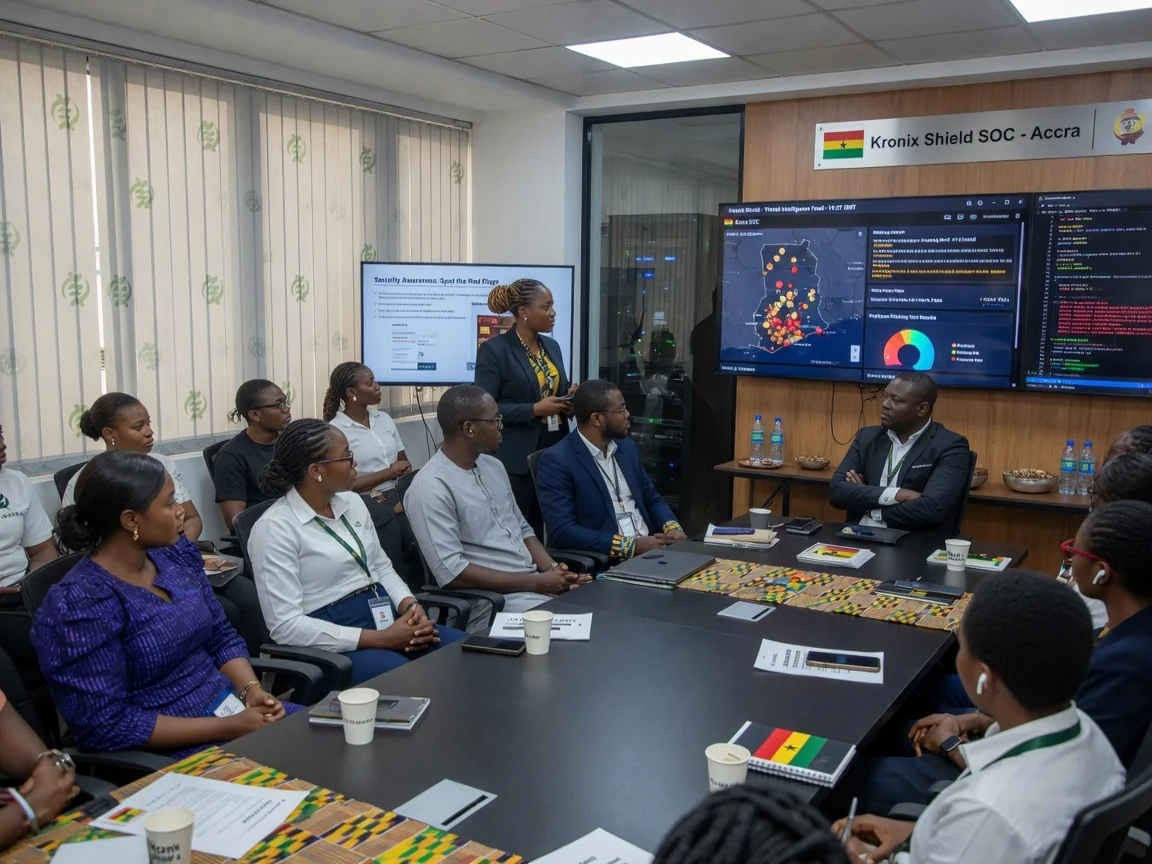

Does Security Awareness Training Reduce Phishing Risk?
Yes — measurably, and the evidence is the point. The human layer is where most institutional breaches begin: a single staff member opening a malicious attachment or entering credentials into a harvesting page can defeat hardened infrastructure. A structured Kronix Shield programme drives down that exposure through baseline assessment, role-calibrated delivery, and controlled phishing simulations that produce documented improvement in staff response rates. The institutions that withstand social-engineering campaigns are the ones that trained for them before the campaign arrived.
When to Specify Security Awareness Training
This programme is specified by institutions that operate under formal governance frameworks — banks, rural and community financial institutions, government ministries and agencies, telecommunications operators, energy utilities, and critical-infrastructure bodies across Ghana and Togo. It is particularly relevant ahead of regulatory compliance audits, following a security incident that implicated staff behaviour, or when an organisation is onboarding significant numbers of new personnel into roles with system access.
Institutions undergoing digital transformation — deploying new enterprise platforms, migrating to cloud-hosted services, or extending remote-access capabilities — are prime candidates. The expansion of an organisation’s digital footprint consistently broadens the human-factor attack surface, and a calibrated awareness programme ensures that operational pace does not outrun staff preparedness.
Methodology — The Kronix Shield Specialist Approach
-
Baseline Assessment. Specialists conduct a structured review of the institution’s current security culture, role profiles, and prior incident patterns. This baseline determines programme scope, depth, and priority threat categories.
-
Curriculum Design. Training materials are developed to reflect the institution’s sector, regulatory environment, and the specific social-engineering and phishing vectors most prevalent in Ghana and Togo. Generic content is not deployed.
-
Facilitated Delivery. Programmes are delivered through structured instructor-led sessions calibrated by staff role and seniority — board-level governance awareness, operational-staff practical threat recognition, and technical-team escalation protocols are addressed as distinct tracks.
-
Simulated Threat Exercises. Controlled phishing simulations and social-engineering scenarios are conducted within the institution’s own environment, generating documented data on staff response rates and identifying cohorts requiring reinforcement.
-
Governance Documentation and Sign-off. All programme outcomes are captured in a formal completion report, including participation records, simulation results, identified gaps, and recommended follow-on actions — providing an auditable evidence trail for regulators and internal governance committees.
Programme Standards & Governance Alignment
- Curriculum mapped to prevailing regulatory guidance issued by the Bank of Ghana, National Communications Authority of Ghana, and equivalent Togolese regulatory frameworks
- Content reviewed against recognised information security governance principles and control frameworks
- Role-differentiated delivery tracks: executive, operational, and technical personnel receive appropriately calibrated content
- Documented evidence trail produced at every stage — from baseline to sign-off
- Simulation exercises conducted under formal scope agreement with institution leadership, ensuring no operational disruption
- All materials subject to pre-delivery review and institutional approval before session commencement
Outcomes & Governance Value
Institutions completing a Kronix Shield security awareness programme leave with a documented, auditable record of staff training activity aligned to their governance obligations. Measured improvement in simulated-threat response rates, clear identification of residual training gaps, and a structured remediation pathway give compliance officers and risk committees the evidence they need. The programme becomes a standing component of the institution’s security governance cycle — reviewed and refreshed as the threat environment and regulatory landscape evolve.
Related Sectors and Solutions
Organisations specifying Security Awareness Training frequently engage Kronix Shield for complementary services including Vulnerability Assessment and Penetration Testing, Security Policy and Governance Advisory, and Incident Response Management — ensuring that human-layer resilience is matched by technical hardening and structured response capability.
Regulated & To Standard
- Ghana’s Cyber Security Authority (CSA) licenses and accredits cybersecurity service providers under the Cybersecurity Act, 2020 (Act 1038) — a mandatory regime with enforcement from 2026; Ghana is the first in Africa to license providers. We operate within it and state our licensing status honestly — never a licence or accreditation we do not hold
- We align our practice and curriculum to ISO 27001, NIST, and CIS — and we are precise that alignment is not certification; we describe only the certifications we actually hold
- Established 2001 — a real cybersecurity services firm with an institutional track record across banking, government, and critical infrastructure
Related Services
- Cybersecurity Services in Ghana — assess, harden, detect, respond
- GRC Advisory — governance, risk, compliance
- Penetration Testing & Security Assessment — find what is exploitable
- Incident Response Support — contain, investigate, recover