
Security Assessment & Advisory
Structured security assessment and advisory for institutional environments, with scoped methodology, documented findings and actionable recommendations.
What is Security Assessment & Advisory?
A security assessment is the disciplined diagnostic that tells an institution where it actually stands — across systems, networks, identities, and processes — before a single cedi is spent on controls. Kronix Shield has run this discipline for institutional clients since 2001. Request a security assessment — or discuss your security posture: +233 20 531 3333.
Security Assessment & Advisory is a structured, methodology-driven engagement through which Kronix Shield maps the current security posture of an institution, identifies control gaps, and delivers documented recommendations calibrated to the organisation’s risk appetite and operational context. It is not a checklist exercise. It is a disciplined diagnostic process — scoped at the outset, conducted with rigour, and concluded with findings an institution can act on with confidence.
Institutions operating in Ghana and Togo specify this service when they require authoritative clarity on where their environments are exposed, how those exposures translate into operational risk, and what a defensible remediation path looks like. Banks, government ministries, telecom operators, energy utilities, and critical-infrastructure operators are among the institutional categories that engage this service as a governance imperative rather than a discretionary activity.
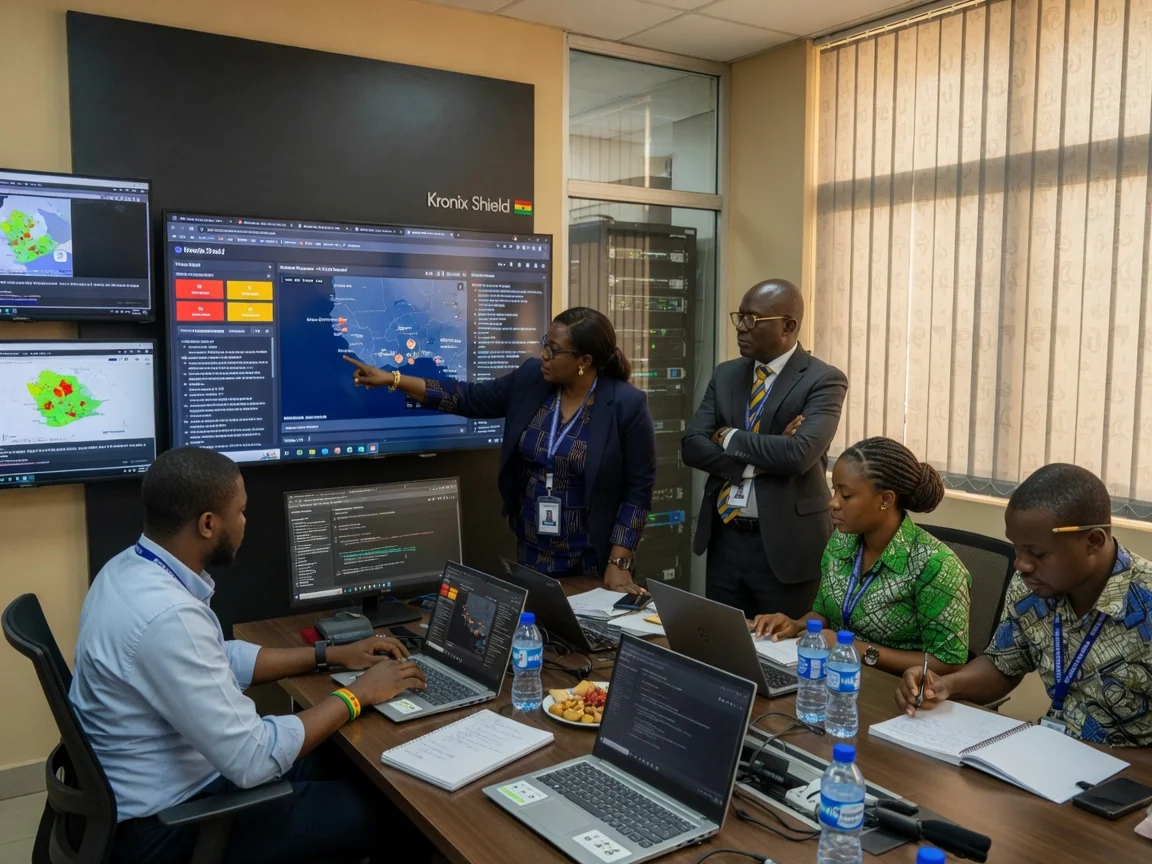


When to Specify Security Assessment & Advisory
This engagement is appropriate at any point where an institution’s risk posture requires formal validation. Common triggers include: a planned technology migration or infrastructure refresh, a regulatory examination cycle, a board-level mandate for third-party security assurance, or a post-incident review where leadership requires independent findings rather than internal attestation.
It is equally relevant as a periodic discipline — commissioned at defined intervals so that the institution maintains a documented, current-state view of its controls, rather than operating on assumptions formed during a previous assessment cycle. In fast-evolving threat environments across both Ghana and Togo, the interval between assessments carries material risk.
Methodology — The Kronix Shield Specialist Approach
-
Scope Definition & Rules of Engagement — The engagement opens with a structured scoping session. Systems, boundaries, assessment depth, and access constraints are formally agreed and documented before any technical work commences. Nothing enters scope by implication.
-
Information Gathering & Environment Review — Specialists conduct structured interviews with technical and operational stakeholders, review network architecture documentation, and gather configuration data across the defined scope. This phase establishes the factual baseline against which controls are measured.
-
Technical Assessment & Control Testing — Depending on engagement depth, specialists conduct vulnerability identification, configuration analysis, access-control review, and logical-perimeter evaluation across in-scope systems. All findings are logged, classified by severity, and cross-referenced to the agreed scope.
-
Risk Analysis & Advisory Synthesis — Raw technical findings are elevated into a risk narrative that speaks to institutional consequence — not just technical detail. Each finding is paired with a prioritised, actionable recommendation appropriate to the institution’s operating context and existing governance framework.
-
Findings Presentation & Documentation Hand-Off — The engagement concludes with a formal findings briefing delivered to the appropriate institutional stakeholders, followed by a structured documentation package — executive summary, detailed technical findings, and a prioritised remediation register — retained by the institution as a governance artefact.
Frameworks & Assessment Discipline
- Process-led engagement with defined scope, entry criteria, and exit criteria documented at each phase
- Risk classification aligned to institutional consequence, not solely technical severity
- Findings documented in formats suitable for board reporting, regulatory review, and internal audit
- Remediation recommendations prioritised by residual-risk reduction and operational feasibility
- Assessment conducted under a formal rules-of-engagement agreement — no scope drift, no undocumented access
- Applicable across on-premise environments, hosted infrastructure, and hybrid operational architectures in Ghana and Togo
Outcomes
An institution concluding a Kronix Shield Security Assessment & Advisory engagement holds a documented, defensible view of its current security posture — a foundation for informed governance decisions, prioritised investment, and credible regulatory dialogue. Leadership has clear sight of where controls hold and where they require strengthening, expressed in language appropriate for both technical teams and executive oversight.
The value is not in the volume of findings. It is in the quality of the risk narrative and the actionability of the remediation register delivered at close.
What It Costs — Honestly
A security assessment is scoped and quoted as a proposal — the cost depends on the size and complexity of your environment, the depth of assessment, and whether it is a one-off engagement or part of a recurring governance cycle. There is no flat published rate; we scope the work properly and quote against your actual environment.
Regulated & To Standard
- Ghana’s Cyber Security Authority (CSA) licenses and accredits cybersecurity service providers under the Cybersecurity Act, 2020 (Act 1038) — a mandatory regime with enforcement from 2026; Ghana is the first in Africa to license providers. We operate within it and state our licensing status honestly — never a licence or accreditation we do not hold
- We align our assessment practice to ISO 27001, NIST, and CIS — and we are precise that alignment is not certification; we describe only the certifications we actually hold
- Established 2001 — a real cybersecurity services firm with an institutional assessment track record across banking, government, and critical infrastructure
Related Services
- Vulnerability Management — find, prioritise, remediate, verify
- Penetration Testing & Security Assessment — prove what is exploitable
- GRC Advisory — governance, risk, and compliance
- Managed Monitoring & Detection — continuous monitoring & triage
- ISO 27001 Readiness — align to the standard, honestly
- Cybersecurity Services in Ghana — the full institutional practice