
Vulnerability Management
Systematic identification, prioritisation and tracked remediation of vulnerabilities across institutional infrastructure, with documented findings at each cycle.
What is Vulnerability Management?
Vulnerability management is a governed, repeating cycle — find, prioritise, remediate, verify — not a point-in-time scan that ages out the moment it is delivered. Kronix Shield has run this discipline for institutional clients since 2001. Request a security assessment — or discuss your security posture: +233 20 531 3333.
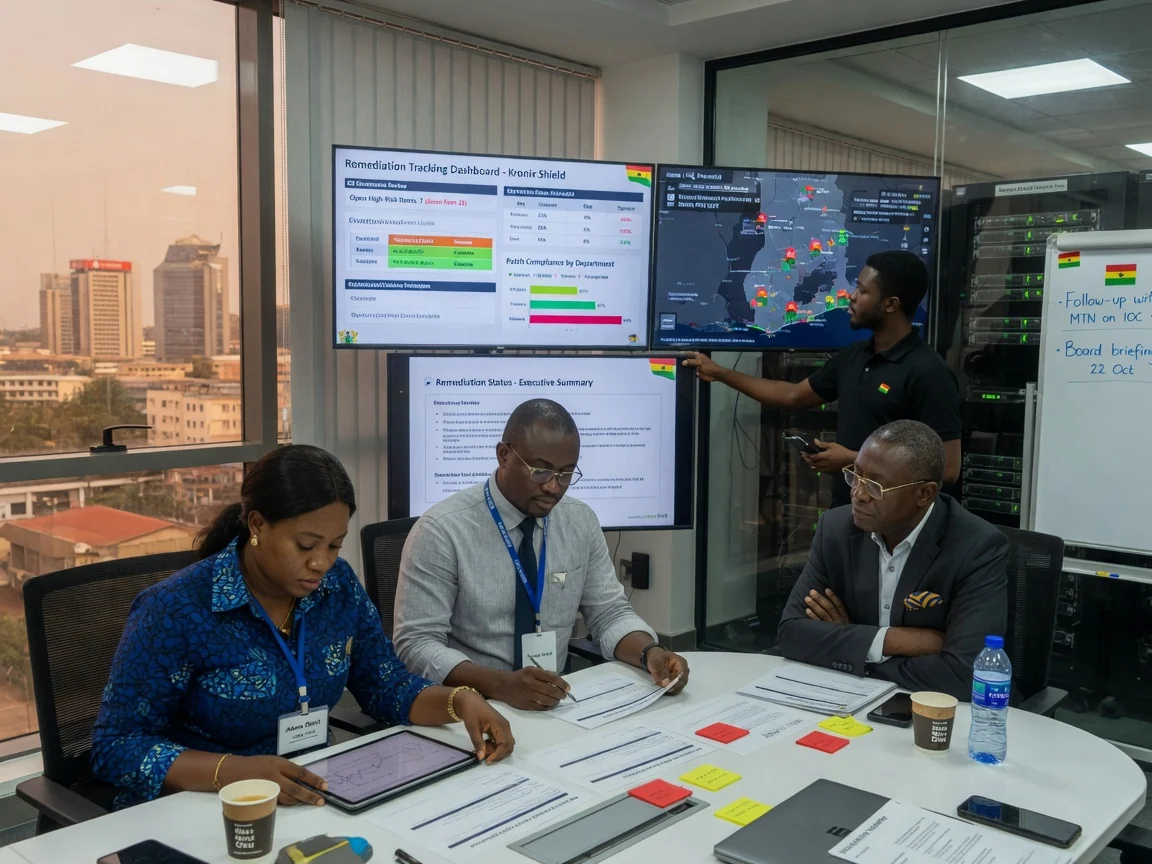
Vulnerability management is the systematic discipline of identifying, classifying, prioritising, and tracking the remediation of security weaknesses across an institution’s infrastructure — covering networks, endpoints, operating systems, applications, and operational technology environments. It is not a point-in-time scan; it is a governed, repeating cycle that produces documented findings, assigned ownership, and verified closure at every stage.
Institutions that specify this discipline — banks, government ministries, telecom operators, energy utilities, and critical-infrastructure bodies — do so because they operate environments where an unpatched weakness is not a theoretical risk. It is a liability with regulatory, operational, and reputational consequence. Kronix Shield structures vulnerability management as a governance instrument, not a technical checkbox.


When to Specify Vulnerability Management
Any institution operating regulated infrastructure in Ghana or Togo that has not established a repeating, documented vulnerability cycle is carrying unquantified exposure. The discipline becomes most critical at points of organisational change: new system deployments, post-acquisition integration, regulatory audit cycles, cloud migration, or following a security incident that demands evidence of corrective action.
Sectors that consistently specify this programme include Tier-1 banking and financial services, government ICT directorates, national utility operators, telecommunications infrastructure teams, and pharmaceutical or manufacturing operators running networked industrial control environments. In each case, the requirement is the same — a defensible, auditable record of what was found, what was prioritised, and what was remediated.
Methodology — The Kronix Shield Specialist Approach
-
Scoping and Asset Discovery — The engagement opens with a structured scoping exercise that maps all in-scope assets across the institution’s environment: on-premises infrastructure, cloud workloads, operational technology, and internet-facing surfaces. No assessment cycle begins without a confirmed, client-approved asset register.
-
Authenticated Scanning and Manual Validation — Automated scanning tools are run with authenticated credentials to surface both external and internal vulnerability classes. Automated findings are then reviewed and validated by Kronix Shield specialists to eliminate noise and false positives before any report is issued.
-
Risk-Based Prioritisation — Each validated finding is scored and contextualised against the institution’s operational environment. A vulnerability in a payment-processing node carries different priority weight than the same finding on an isolated test workstation. Prioritisation is governance-driven, not algorithm-default.
-
Documented Findings and Remediation Tasking — A formal findings report is issued with each vulnerability carrying an assigned severity tier, a recommended remediation action, and a tracked owner within the institution. Kronix Shield does not deliver reports and disengage; the findings cycle includes remediation guidance aligned to the institution’s change-management process.
-
Verification and Cycle Closure — Following remediation activity, Kronix Shield conducts re-testing to verify that identified vulnerabilities have been resolved and that no regression has occurred. The cycle closes with a verified closure record — a document suitable for regulatory review, board reporting, or external audit.
Assessment Framework and Standards Alignment
- Vulnerability classification aligned to recognised severity scoring frameworks
- Asset inventory discipline maintained throughout the engagement cycle
- Findings documentation structured for regulatory and board-level review
- Remediation tracking integrated with the institution’s internal governance processes
- Re-testing protocols applied before any cycle is formally closed
- All deliverables produced under Kronix Shield’s documented quality and review process
Outcomes for the Institution
Institutions that operate a governed vulnerability management cycle carry a materially different risk posture than those that do not. The outcome is not only a remediated environment — it is an auditable record of continuous security discipline that satisfies regulatory examiners, informs board-level risk reporting, and demonstrates due diligence to institutional counterparties.
The programme is designed to integrate with existing IT governance and change-management frameworks, producing minimal operational disruption and maximum documentation quality at every cycle.
What It Costs — Honestly
A vulnerability management programme is scoped and quoted as a proposal — the cost depends on the number and criticality of in-scope assets, the depth of validation, and the cadence of the cycle, so there is no flat published rate. We scope it properly and quote against your actual environment.
Regulated & To Standard
- Ghana’s Cyber Security Authority (CSA) licenses and accredits cybersecurity service providers under the Cybersecurity Act, 2020 (Act 1038) — a mandatory regime with enforcement from 2026; Ghana is the first in Africa to license providers. We operate within it and state our licensing status honestly — never a licence or accreditation we do not hold
- We align our practice to ISO 27001, NIST, and CIS, and classify vulnerabilities against recognised severity scoring frameworks — and we are precise that alignment is not certification; we describe only the certifications we actually hold
- Established 2001 — a real cybersecurity services firm with an institutional track record across banking, government, and critical infrastructure
Related Services and Solutions
Vulnerability management operates most effectively as part of a broader security governance programme. Clients frequently specify this service alongside Kronix Shield’s Penetration Testing, Continuous Security Monitoring, and Governance, Risk and Compliance Advisory engagements — building a layered, documented security posture across the institution.
- Security Assessment & Advisory — the diagnostic that sets direction
- Penetration Testing & Security Assessment — prove what is exploitable
- Managed Monitoring & Detection — continuous monitoring & triage
- GRC Advisory — governance, risk, and compliance
- Infrastructure Hardening — close the exploitable gaps
- Cybersecurity Services in Ghana — the full institutional practice